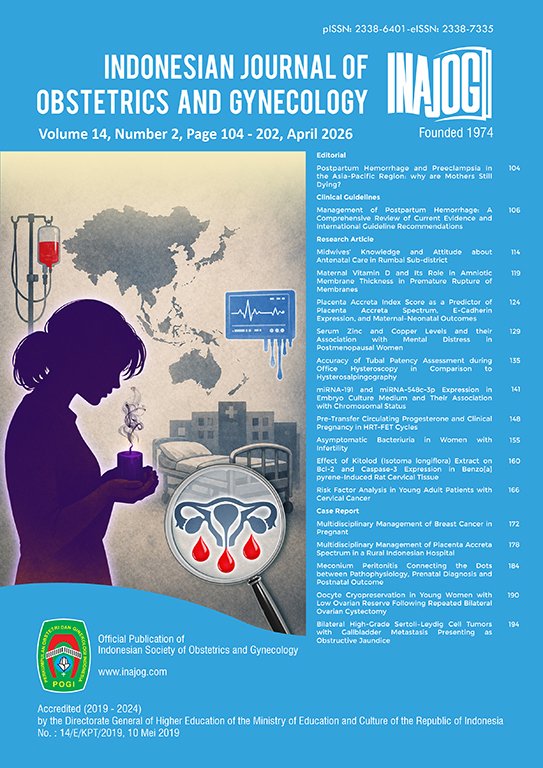
Risk Factor Analysis in Young Adult Patients with Cervical Cancer
DOI:
https://doi.org/10.32771/inajog.v14i2.2191Abstract
Objective: To identify risk factors associated with cervical cancer and determine the strongest predictors among young adults at Prof. Dr. R.D. Kandou General Hospital.
Methods: This study employed an analytical case–control design. Sampling was performed using a total sampling method, including all cervical cancer patients aged <45 years treated at Prof. Dr. R.D. Kandou General Hospital from January 2022 to June 2023. The independent variables included educational level, occupation, nutritional status, age at first sexual intercourse, multiple sexual partners, type of contraception, and parity. Associations between variables were analyzed statistically.
Results: A total of 210 participants were included, comprising 105 cases and 105 controls. The most common age group
was 30–39 years (51%). The predominant histopathological type was squamous cell carcinoma (82%), and most cases were diagnosed at stage IIB–IIIC1r (73%). Educational level (p=0.318) and occupation (p=0.972) were not significantly associated with cervical cancer in young adults. In contrast, normal nutritional status (p<0.001), age at first sexual intercourse ≤18 years (p<0.001), multiple sexual partners (p<0.001), use of hormonal contraception (p<0.001), and multiparity (p<0.001) were significantly associated with cervical cancer in young adults.
Conclusions: Early age at first sexual intercourse (≤18 years), multiple sexual partners, use of hormonal contraception, and multiparity are significant risk factors for cervical cancer in young adults.
Keywords: cervical cancer, risk factor, young adult
Downloads
Downloads
Published
Versions
- 2026-04-22 (1)
- 2026-04-22 (1)
How to Cite
Issue
Section
License
Copyright (c) 2026 Indonesian Journal of Obstetrics and Gynecology

This work is licensed under a Creative Commons Attribution-NonCommercial-ShareAlike 4.0 International License.