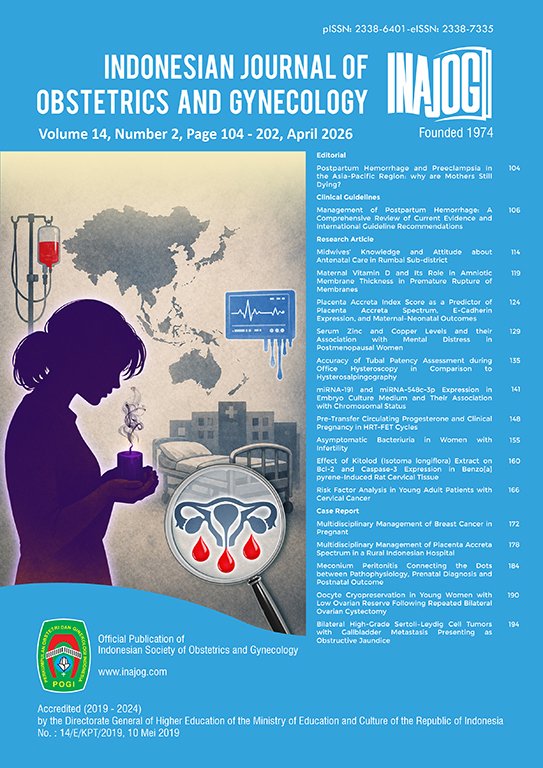
Serum Zinc and Copper Levels and their Association with Mental Distress in Postmenopausal Women
DOI:
https://doi.org/10.32771/inajog.v14i2.3085Abstract
Abstract
Objective: To investigate the relationship between serum zinc (Zn) and copper (Cu) levels and mental distress in postmenopausal women.
Methods: This cross-sectional study included 87 postmenopausal women. Participants with a history of hysterectomy or
estrogen therapy were excluded. Mental distress was assessed using the Self-Reporting Questionnaire-20 (SRQ-20). Serum Zn and Cu concentrations were measured using Inductively Coupled Plasma Mass Spectrometry (ICP-MS). Data were analyzed using SPSS version 25, employing independent t-tests, Mann–Whitney tests, and Pearson correlation analysis.
Results: The mean serum zinc levels in participants with and without mental distress were 67.93 ± 9.03 µg/dL and 71.07 ±
12.99 µg/dL, respectively (p = 0.390). The mean serum copper levels were 129.38 ± 12.31 µg/dL in participants with mental
distress and 131.78 ± 18.22 µg/dL in those without (p = 0.638). No significant correlations were found between serum zinc or copper levels and mental distress (r = -0.03, p = 0.775; r = -0.002, p = 0.984, respectively). These findings suggest that zinc and copper may not serve as reliable biomarkers for screening mental distress in postmenopausal women.
Conclusion: Serum zinc and copper levels were not significantly associated with mental distress in postmenopausal women.
keywords: copper, mental distress, postmenopausal, zinc.
Downloads
Downloads
Published
Versions
- 2026-04-22 (1)
- 2026-04-22 (1)
How to Cite
Issue
Section
License
Copyright (c) 2026 Indonesian Journal of Obstetrics and Gynecology

This work is licensed under a Creative Commons Attribution-NonCommercial-ShareAlike 4.0 International License.