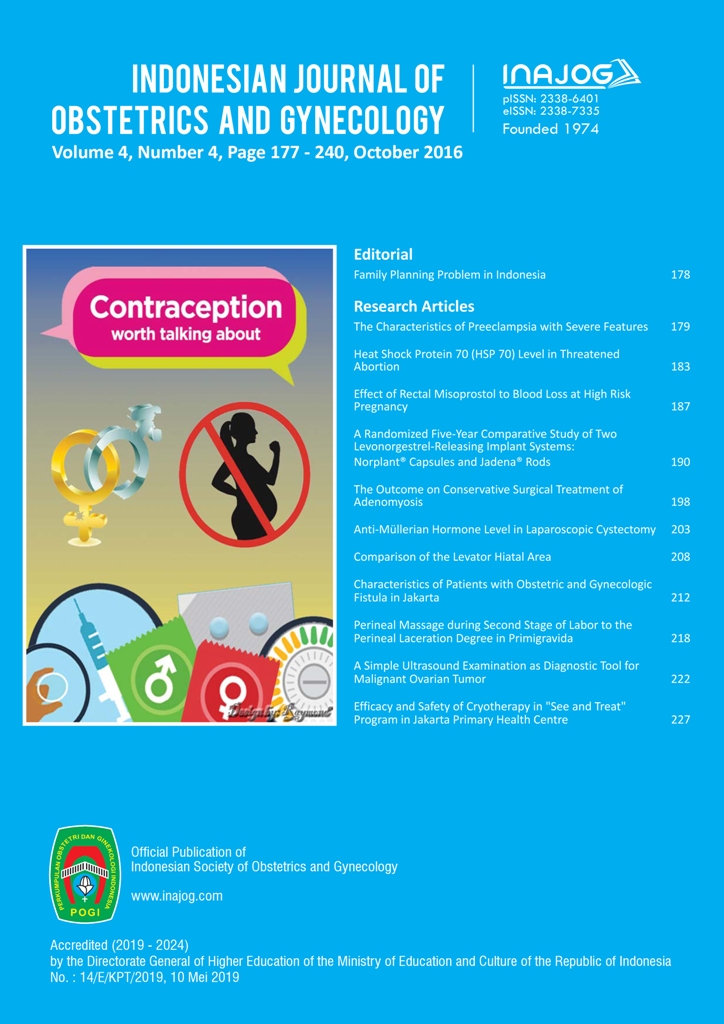
The Outcome on Conservative Surgical Treatment of Adenomyosis

Authors

  • Budi Wiweko Faculty of Medicine Universitas Indonesia/ Dr. Cipto Mangunkusumo General Hospital Jakarta
  • Ario Legiantuko Faculty of Medicine Universitas Indonesia/ Dr. Cipto Mangunkusumo General Hospital Jakarta
  • Achmad Kemal Faculty of Medicine Universitas Indonesia/ Dr. Cipto Mangunkusumo General Hospital Jakarta
  • Gita Pratama Faculty of Medicine Universitas Indonesia/ Dr. Cipto Mangunkusumo General Hospital Jakarta
  • Herbert Situmorang Faculty of Medicine Universitas Indonesia/ Dr. Cipto Mangunkusumo General Hospital Jakarta
  • Kanadi Sumapraja Faculty of Medicine Universitas Indonesia/ Dr. Cipto Mangunkusumo General Hospital Jakarta
  • Muharam Natadisastra Faculty of Medicine Universitas Indonesia/ Dr. Cipto Mangunkusumo General Hospital Jakarta
  • Andon Hestiantoro Faculty of Medicine Universitas Indonesia/ Dr. Cipto Mangunkusumo General Hospital Jakarta

DOI:

https://doi.org/10.32771/inajog.v4i4.448

Abstract

Objective: To understand the outcome on conservative surgical treatment of adenomyosis. Methods: A retrospective cohort study followed for 2 years from 2010 to 2012 of women with adenomyosis were diagnosed by transvaginal sonography and confirmed histologically. Subjects divided into women who were treated by adenomyosis resection (with/without Osada’s technique) and who were underwent hysterectomy. Results: After the surgery, as many as 40 patients (81.63%) did not feel any pain (VAS 0), and 9 patients (18.37%) still felt pain. For the fertility outcome, we had 8 patients (20.51%) getting pregnant naturally without any fertility intervention. Two patients (5.13%) had successfully conceived by IVF. According to the type of surgery, from 8 natural pregnancy, 7 patients (87.50%) was underwent conventional resection of adenomyosis and 1 patients (12.50%) underwent Osada’s procedures. Two patients who were conceived by IVF, both of them were underwent Osada’s resection. Conclusion: Adenomyosis resection both conservative or Osada’s procedures actually has a better outcome for relieving pain; therefore, some patients can still have a child. Keywords: adenomyosis resection, conventional resection, infertility, Osada’s procedure

Downloads

Download data is not yet available.
Author Biographies

Budi Wiweko, Faculty of Medicine Universitas Indonesia/ Dr. Cipto Mangunkusumo General Hospital Jakarta

Department of Obstetrics and Gynecology

Ario Legiantuko, Faculty of Medicine Universitas Indonesia/ Dr. Cipto Mangunkusumo General Hospital Jakarta

Department of Obstetrics and Gynecology

Achmad Kemal, Faculty of Medicine Universitas Indonesia/ Dr. Cipto Mangunkusumo General Hospital Jakarta

Department of Obstetrics and Gynecology

Gita Pratama, Faculty of Medicine Universitas Indonesia/ Dr. Cipto Mangunkusumo General Hospital Jakarta

Department of Obstetrics and Gynecology

Herbert Situmorang, Faculty of Medicine Universitas Indonesia/ Dr. Cipto Mangunkusumo General Hospital Jakarta

Department of Obstetrics and Gynecology

Kanadi Sumapraja, Faculty of Medicine Universitas Indonesia/ Dr. Cipto Mangunkusumo General Hospital Jakarta

Department of Obstetrics and Gynecology

Muharam Natadisastra, Faculty of Medicine Universitas Indonesia/ Dr. Cipto Mangunkusumo General Hospital Jakarta

Department of Obstetrics and Gynecology

Andon Hestiantoro, Faculty of Medicine Universitas Indonesia/ Dr. Cipto Mangunkusumo General Hospital Jakarta

Department of Obstetrics and Gynecology

How to Cite

1.
Wiweko B, Legiantuko A, Kemal A, Pratama G, Situmorang H, Sumapraja K, et al. The Outcome on Conservative Surgical Treatment of Adenomyosis. Indones J Obstet Gynecol [Internet]. 2016 Oct. 7 [cited 2026 Jul. 26];4(4):198-202. Available from: https://www.inajog.com/index.php/journal/article/view/448

Issue

Section

Research Article

Most read articles by the same author(s)

1 2 3 4 5 > >>